The endless hours between lunch and dinner are painful enough as it is—made even worse when you’re traveling and away from your kitchen. Whether you’re actually hungry or just need something to munch on to pass the time, tap into the food-oriented brains of some top chefs for their best snacking practices.
Don’t pack lightly
For everything from road trips to air travel, Fung Tu’s Jonathan Wu packs his go-to breakfast sandwich: a toasted poppy seed bagel with a fried egg, avocado and pimentos.
Stella Barra chef Jeff Mahin brings individual nut butter-honey packets, citing the protein and sugar combo as the perfect pick-me-up. But remember that if you’re airport bound, you’ll have to keep liquids to a minimum, which is why he also brings snack packs of trail mix. What else will you find in his carry-on? Dried meat. “I have a soft spot for beef jerky.”
Try the DIY lifestyle
Granola bars are generally delicious, and there’s no beating the convenience, but boxes of granola bars can get expensive. So, be like Mahin and make your own. He purées a mixture of soaked oats, almond milk, almond butter, raisins, cinnamon and vanilla, then boils it before letting it set in a baking dish.
Like Mahin, chef Brian Landry of New Orleans restaurant Borgne is a fan of beef jerky on road trips, specifically, the kind that’s homemade by one of his sous chefs.
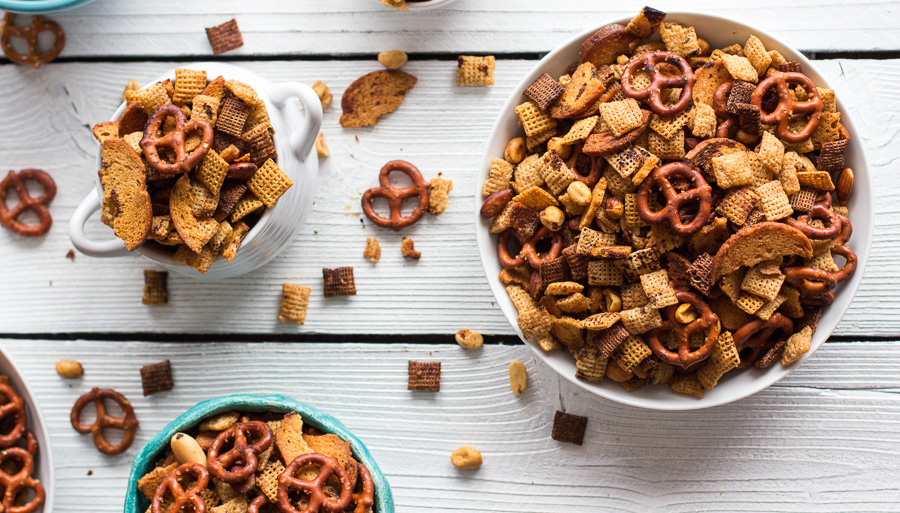
Miss Lily’s executive chef Adam Schop makes a mean Chex mix, using pick-a-pepper sauce over Worcestershire for a Jamaican twist.
Find your inner junkie
Rule number one of vacation: travel calories don’t count. Schop says when he’s on the road, he craves Samoas, the classic Girl Scout cookie. And though nowadays Wu travels with KIND bars and other granola snacks, that wasn’t always the case.
“As a kid when traveling with just my Dad, we had many ‘breakfasts’ on trains consisting solely of pizza-flavored Combos!”
Mahin totes around snack-size packets of Nutella, a trick that “makes it easier to justify than eating an entire regular-size jar.”
Landry feels the same way, saying his guilty pleasure is a quality bar of chocolate. “Preferably with almonds or sea salt.”
Embrace the surroundings
While it’s tempting to try and bring all your favorite snacks from home, traveling is the perfect time to try new foods.
Though Landry always tries gulf seafood (“I love seeing what people in other parts of the country are doing with the product caught right at my back door”), he also likes to try different flavored potato chips like jamon, crab and octopus.
“I try my best to eat like the locals,” Wu says. That’s how he discovered—and fell in love with—Sino-Indian food while traveling in India.
Mahin agrees: “I like finding honest food in cities.” The roadside shack could end up being a hidden gem—maybe even your next travel destination itself.
Dining Out, a print and web-based publication that delivers the latest culinary world news and our new media partner (yay!), recently published a great article about rising technology in the restaurant industry. Here are a few of the highlights…
Wine list goes digital: Wine-centric restaurants are switching from printed wine lists to the digital variety, usually hosted on an iPad or tablet of some sort. Since the first occurrence in Atlanta restaurant Bones back in 2010, many have followed suit because digital wine lists not only allow customers to access more information, but also make it easier for the restaurant to make content changes.
Checks delivered straight to your smartphone: Reservation companies like OpenTable, which work from a central point-of-sales system in each restaurant, now allow servers to push checks through the same system directly to the customer’s app.
Servers replaced by digital ordering interface: Chain restaurants are introducing tableside terminals and tablets for ordering, which similar to the digital wine list, gives restaurants flexibility with their menus as well as an easy way for customers to redeem promotions. The trade-off is the lack of hospitality, a main part of the restaurant experience that many believe will be missed if this trend goes mainstream.
Waitlist apps that shorten wait time: Apps like Waitlist Me and NoWait are making it more convenient for customers to wait for tables. While some just provide text message alerts that allow customers to go off site during the wait, others are completely remote, providing the ability to put your name on the list from home.
Digitized taphouses let you pour your own: Cutting down on labor costs and giving customers a unique experience, taphouses like Denver’s First Draft lets guests pour their own craft beer and wine by swiping a magnetic card for every round. Unlike the digital ordering interfaces mentioned above, First Draft is keeping hospitality at a premium with Beer Ambassadors to help customers choose from their 40+ beer and wine options. If you’re interested in joining their team, check out First Draft’s open jobs on Sirvo.
Read the full article for a closer look at technology in the restaurant world.
One of the biggest challenges in the food and beverage industry is hiring qualified and capable employees and keeping them around for the long run. The average day in the life of a food and beverage worker can be stressful, and using motivational techniques to inspire and support your staff will not only improve the quality of work but also increase the liklihood that they’ll stick with you.
Use these tips to incorporate a dose motivation into the daily management of your staff and watch them succeed!
Focus on the positive
Have you ever had a manager who put a spotlight on everything that was going wrong during the pre-shift meeting? Nothing beats people down more than only hearing about the things they have done wrong. The things that your staff needs to improve upon do need to be addressed, but addressing them in a constructive way is more likely to have a positive effect.
Try the “sandwich” technique. Begin by talking about some positive things you have seen in your employees. Maybe celebrate the successes of each individual employee. Then discuss things that need improvement. Then, conclude by thanking your staff for their hard work. By sandwiching the negative between two positives, your staff will feel encouraged, instead of discouraged.
Keep the acknowledgement coming
Have ongoing acknowledgement programs, like “Employee of the Month”. Designate an area in the back of the house where the successes of your staff members can be posted. If a customer writes a good review of your restaurant or the staff, post it there. Regularly update the postings, making sure to rotate through the whole staff.
Have daily goals
Create daily goals for your staff to work towards. Do you manage a steakhouse? Offer a reward to the server who sells the most of a certain type of steak. Does your restaurant specialize in fine wine? Set a wine sales goal for the server who has the highest wine sales.
The reward can be anything from a free meal to a gift card. Make it interesting by creating teams, and having your employees work together to achieve a goal.
Set monthly goals as well
If your daily goals are for a small reward, create a larger goal for the entire month. For example, set a goal for the staff member with the highest monthly sales, with nothing under a certain amount. The reward could be something like a $500 bonus or a paid day off.
Set up a continuing education program
If your employees feel like you care about them, it will show in the quality of their work. Investing in their future by offering further job training and education shows them you care, and it will increase the likelihood that they will stick with you long-term.
Provide opportunities to cross train within your restaurant, and if promotion is possible, try to do it from within.
Get your hands dirty
In a restaurant’s busiest moments, it’s easy for a manager to shout out for someone to cut lemons or roll silverware, but that may send the wrong message to your staff. Show them that you aren’t above tasks like these.
When it’s obvious a staff member could use an extra pair of hands, roll up your sleeves and help out. One of the characteristics of a good leader is to lead by doing not by telling.
Feed your staff
If you have ever worked as a server or cook, you know often it is that you go an entire shift without getting the opportunity to sit and eat. Provide these short breaks for employees to grab a bite if possible.
For shifts that are really busy, bring in breakfast, lunch, or dinner every now and then. This is another way to show your employees that you care, and they won’t have to try to get through a shift on empty stomachs!
The food and beverage industry is a stressful, but rewarding one. By following these tips, you’ll motivate your staff and encourage them to work towards being a valuable part of the team!
“Oh man, last night’s service… we were so weeded! Food’s dying on the pass. The rail is jammed up with dupes. The salamander stopped working. My porter no-showed. I really thought we might go down.”
If you’ve never worked in a restaurant, this little snippet might as well be written in Sanskrit. Like all occupations, the professional kitchen has developed its own vernacular—one that is at once clever, efficient, and sometimes a little crude. While each kitchen will have its own unique patois, the basics are the same.
Here’s your guide to common kitchen slang:
ON THE LINE
The “line” is the kitchen space where the cooking is done, often set up in a horizontal line. Being “on the line” means you are a “line cook”—an essential foot soldier in any functioning restaurant.
RUNNING THE PASS
The “pass” is the long, flat surface where dishes are plated and picked up by service staff. The chef or high-level cook who “runs the pass” each night is in charge of letting the cooks know what they will be cooking as orders come in. They are in control of the watching the order tickets, monitoring the speed and rhythm of the coursing, and making sure each dish looks good before it goes out to the customer.
5 OUT
Coordination is essential for any busy kitchen where there are multiple cooks in charge of different dishes, components, and garnishes for every plate. When a cook yells “5 out” or “3 out on sirloin,” it signals to the other cooks that they will be ready to plate in said amount of time.
SOIGNE
Mostly used by wannabe fine-dining douchebags, soigne (pronounced “SWAN-YAY”) means “elegant” in French. It’s used to describe an exceptionally sexy dish, or when you really nailed a plating presentation.
A LA MINUTE
A la minute is French for “in the minute,” and it refers to making a dish right then, from scratch. Instead of making a big batch of risotto during prep time and reheating portions of it hours later, a dish made “a la minute” is cooked from start to finish only when an order for it comes in.
MISE
Short for mise en place (French for “everything in its place”), this term refers to all of the prepped items and ingredients a cook will need for his specific station, for one night of service. E.g., Chef: “Did you get all of your mise done?” Cook: “I just need to slice shallots for the vin(aigrette), chef, then I’m ready.”
kitchenlingo_atala
12-TOP/4-TOP/DEUCE
A “12 Top” refers to a table with 12 diners. A “4 top” has four diners. A “deuce” just two.
NO SHOW
A “no-show” is a kitchen employee who doesn’t show up to work. No-shows are undeniable assholes.
ON DECK/ON ORDER
As tickets shoot out from the kitchen printer, the cook running the pass will let the cooks know what they have “on deck”—for example, “4 steak, 2 quail, 1 blue, on order”—so the cooks can mentally prepare and start setting up what they will be cooking throughout a diner’s meal.
FIRE
When a chef calls out “fire” or “pick-up,” a cook will start cooking that particular dish (e.g., “FIRE! 6 broco, 3 polenta side, 1 lamb”) “Order fire” means to immediately start cooking a certain dish because there is only one course on the ticket, much to the annoyance of the kitchen (because it forces them to restructure the entire pick-up). “Pick-up” can also be used as a noun, as in “I had to re-do my entire pick-up because some jabroni order-fired a porterhouse.”
RUN THE DISH When a dish of plated food that is ready to go out to the dining room, cooks will “run the dish.” Servers ask, “Can you run?”, when they are waiting to ferry the food out of the kitchen.
DYING ON THE PASS
Hot food that is ready to be run that has been sitting on the pass for an inordinate amount of time getting cold and losing its soigne character because waitstaff are either too slammed or too lazy to pick it up.
86’D
When the kitchen runs out of a dish, it’s “86’d.” Dishes can also be 86’d if the chef is unhappy with the preparation and temporarily wants it off the menu. Patrons can be 86’d, too.
One of the earliest documented usages of this term was at the bar Chumley’s in downtown Manhattan during Prohibition. The bar had an entrance on Pamela Court and an exit at 86 Bedford Street. Police would call ahead to warn the bartenders of a possible raid, telling them to “86” their customers out of the 86 exit door.
WEEDED / IN THE SHIT / IN THE WEEDS
Used when a cook is really fucking busy, overwhelmed by tickets, and frantically trying to cook and plate his dishes.
THE RAIL / THE BOARD
This refers to the metal contraption that holds all of the tickets the kitchen is working on. Once a ticket is printed, it’s stuck to “the rail” or “the board.” “Clearing the board” means the kitchen has just worked through a large set of tickets.
CHECK YOUR PLATES!
Every open kitchen where the cooks can actually see patrons will have a term that signals that an attractive man or woman is in the dining room. It might also be “Ace!” or “Yellowtail!” or whatever the kitchen comes up with.
THE SALAMANDER / ROBOCOP / SIZZLE / COMBI Kitchen equipment names often get abbreviated or nick-named.
“salamander” is a high-temperature broiler
“robocop” is a food processor
“sizzle” is a flat, metal broiler plate
“combi” is an oven with a combination of heating functions
“fishspat” is a flat-angled metal spatula good for cooking fish
“spider” is a wire skimmer
“chinacap” is a cone-shaped colander
“low-boy” is a waist-high refrigerator
There’s a million of them…
VIPS / PPX / NPR “Very Important Person,” “Persone Txtrodinaire,” and “Nice People Get Rewarded” written on a ticket signals to all staff that their work should be top-notch for these diners. It can be industry, celebrities, friends, or family—they all get hooked up.
CUPCAKING
Mostly for bartenders, “cupcaking” is used when a barkeep is spending noticeably too much time and attention on an attractive patron sitting at the bar.
FLASH
If a piece of protein is slightly undercooked, a cook will “flash it” in the oven for a minute or two to raise the temperature.
SANCHO When a cook sneezes, a co-worker will announce “SANCHO.” This is in the Mexican tradition of pointing out that someone named “SANCHO” or “SANCHA” is in your house banging your wife or boyfriend while you are at work. It’s a funny dig. The proper response is, “No mames guey! I’m not worried about Sancho.”
SHORT
To be missing a component of a dish or an ingredient, as in, “Dammit, I’m one meatball short!”
DUPE Short for “duplicate.” When tickets are printed in the kitchen, they are usually printed on two- or three-ply color-coded paper which signify courses. This allows the person running the pass to keep track of and discard layers as courses leave the kitchen, as in, “Gimme that dupe, I gotta cross off the apps.”
BUKKAKE
Does your dish have a swipe of yogurt, a squiggle of cream, or a splash of creme fraiche on it? That’s “bukkake.”
⅛ PAN, ⅙ PAN, ⅓ PAN, HOTEL
The standardized, stackable metal pans that cooks use to braise meat, carry vegetables, and roast things in are called “hotel pans,” which can be deep or shallow. There are many pans of different sizes and shapes that relate in volume to the hotel pan: three ⅓ pans can fit into a hotel, six ⅙ pans make up one hotel, eight ⅛ pans, etc.
BEHIND / ATRAS
In the fast-paced ballet of cramped kitchen spaces, cooks let their co-workers know they are moving behind them so there are no unnecessary collisions. When carrying knives, heavy hotel pans, and pots of burning liquid, the usual call is, “HOT BEHIND!” Atrás is Spanish for “behind.”
LEFT-HANDED SPATULA / BACON STRETCHER
These items do not exist. But tell a green cook to grab a “left-handed spatula” for you and watch the frantic search begin. Hilarious!
GETTING A PUSH
During service, work on the line usually comes in waves. When the tickets start printing faster and the restaurant is getting busier, the kitchen is “getting a push.”
CROPDUSTING
Cropdusting is farting, intentionally or accidentally, while moving down the line. Also works for wait staff, as in, “Goddamn table 17 is the fucking worst! When I drop their check I’m going to try and cropdust them.”
BURN THE ICE Disposing of the ice in the ice machine under your mise, or at the bar by pouring hot water over it.
SOS
Sauce on the side.
ALL DAY
This refers to the total amount of dishes a cook is cooking in one specific pick-up. It works as a clarification system between the chef and cook. The cook might say, “Chef, how many linguine am I working?!” or “Can you give me an all-day, Chef.” The chef would reply, “You’ve got 4 linguine, 3 spaghetti, 2 cappelletti, and 2 kids pastas, all day”
WAXING A TABLE
Giving a table VIP treatment.
‘Kitchen slang strengthens workplace solidarity, confuses the uninitiated, and is often peppered with a shocking amount of expletives.’
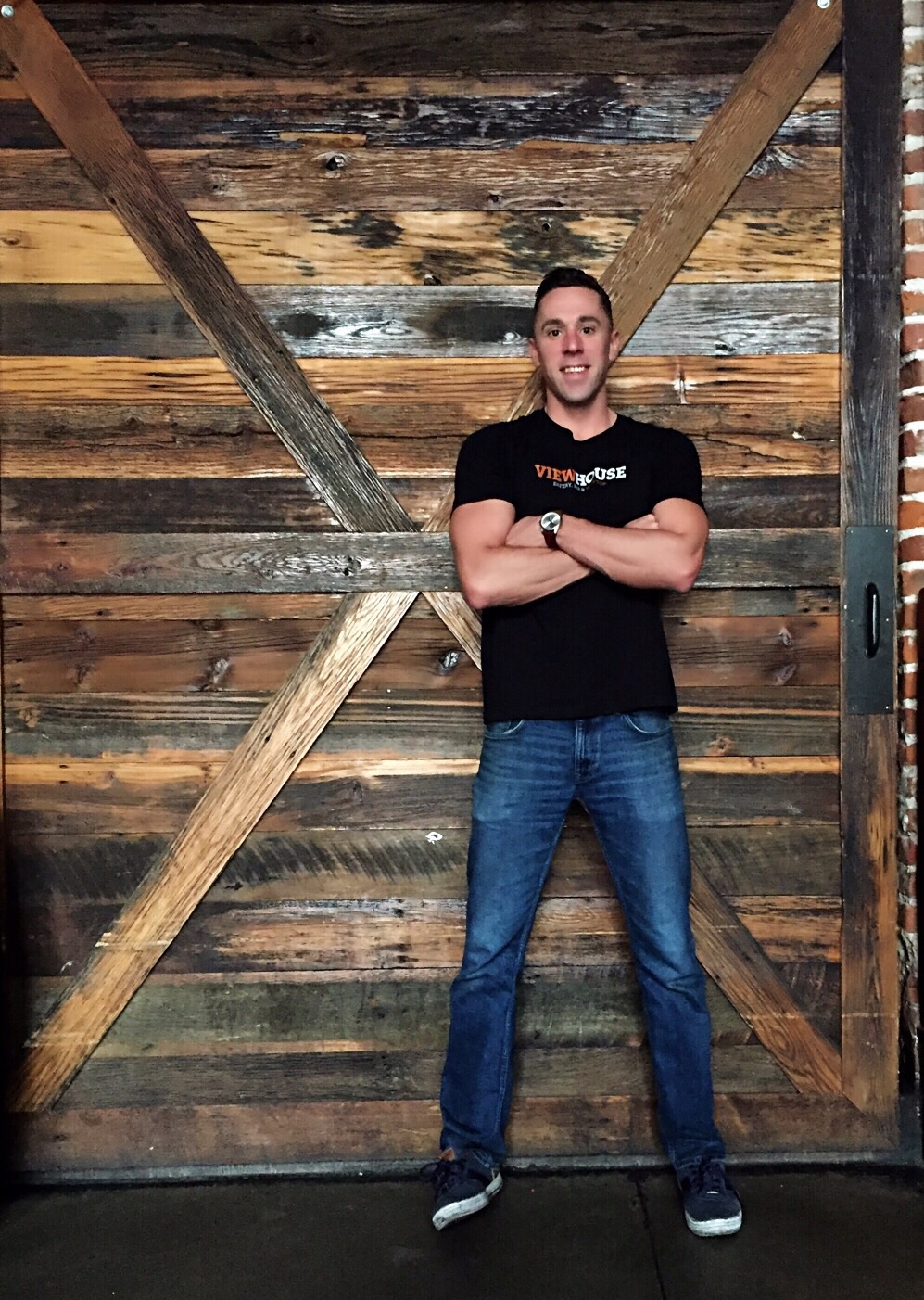
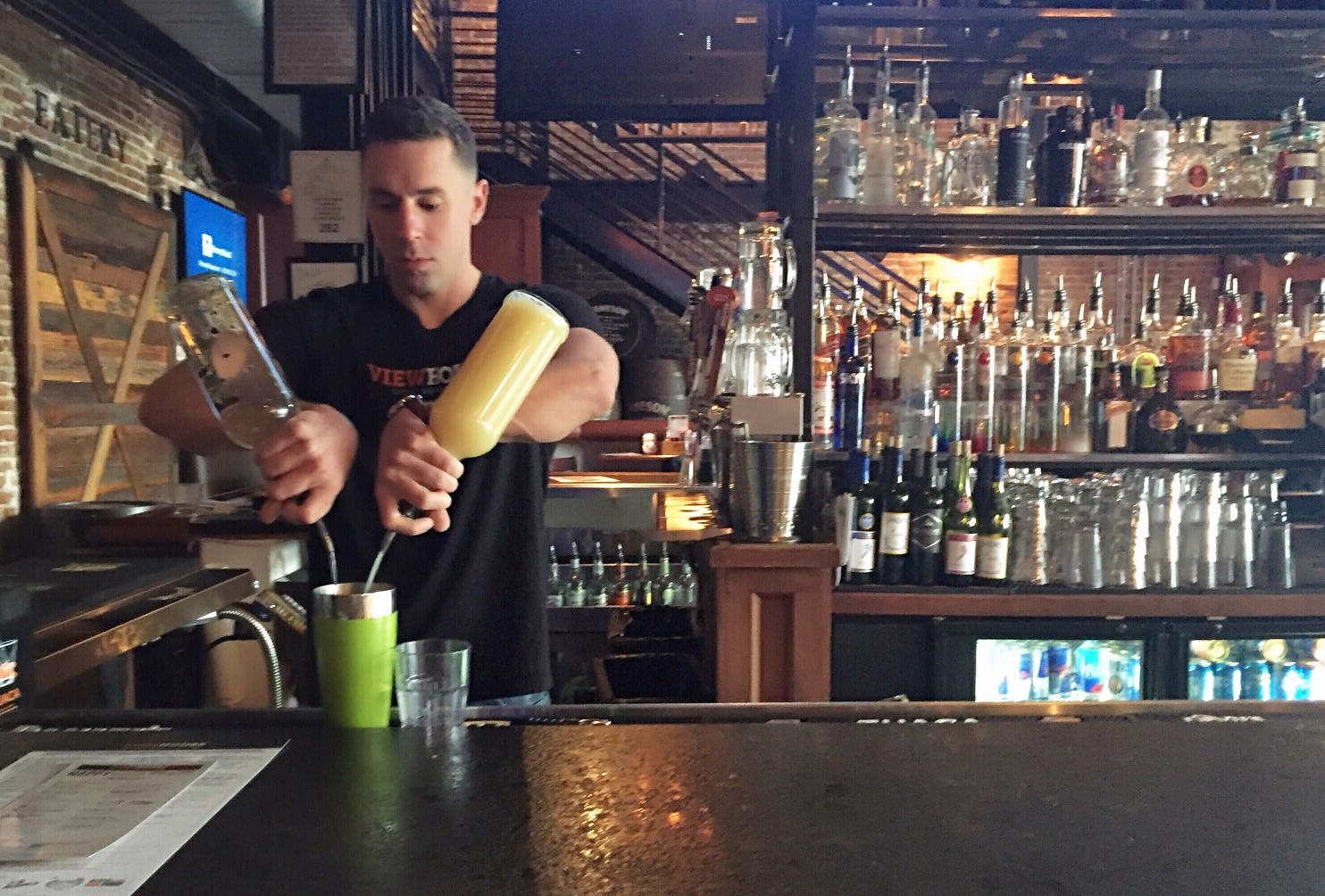
Working the bar at the ViewHouse, one of Downtown Denver’s most popular destinations no matter the time of day, takes serious skill, endurance, and personality. And Dane Hatch, their lead bartender, makes it look like a walk in the park, so we sat down with him to find out how he does it without breaking a sweat.
What first attracted you to bartending?
I had a roommate in Telluride who was a bartender and he always seemed to have too much fun! I love meeting new people so it was a perfect fit.
Where did you get your start?
A bar called Tracks Cafe & Bar in Telluride.
Did you ever go to bartending school?
I never went. It wasn’t required. I feel like bartending is a skill that just takes time behind the bar.
What was the best piece of advice you’ve ever received?
Always keep your head up and on a swivel. Always know what your next move is going to be.
Who do you look to for inspiration?
There is always going to be someone that’s better than you at certain tasks. I’ve tried to learn from everyone I’ve ever worked with.
What’s your least favorite drink to make?
AMF…
Do you have any tricks you use to connect to customers or maximize your efficiency behind the bar?
Every guest is different, so I try to read the type of person they are and their mood when they sit down.
Do you have a signature cocktail?
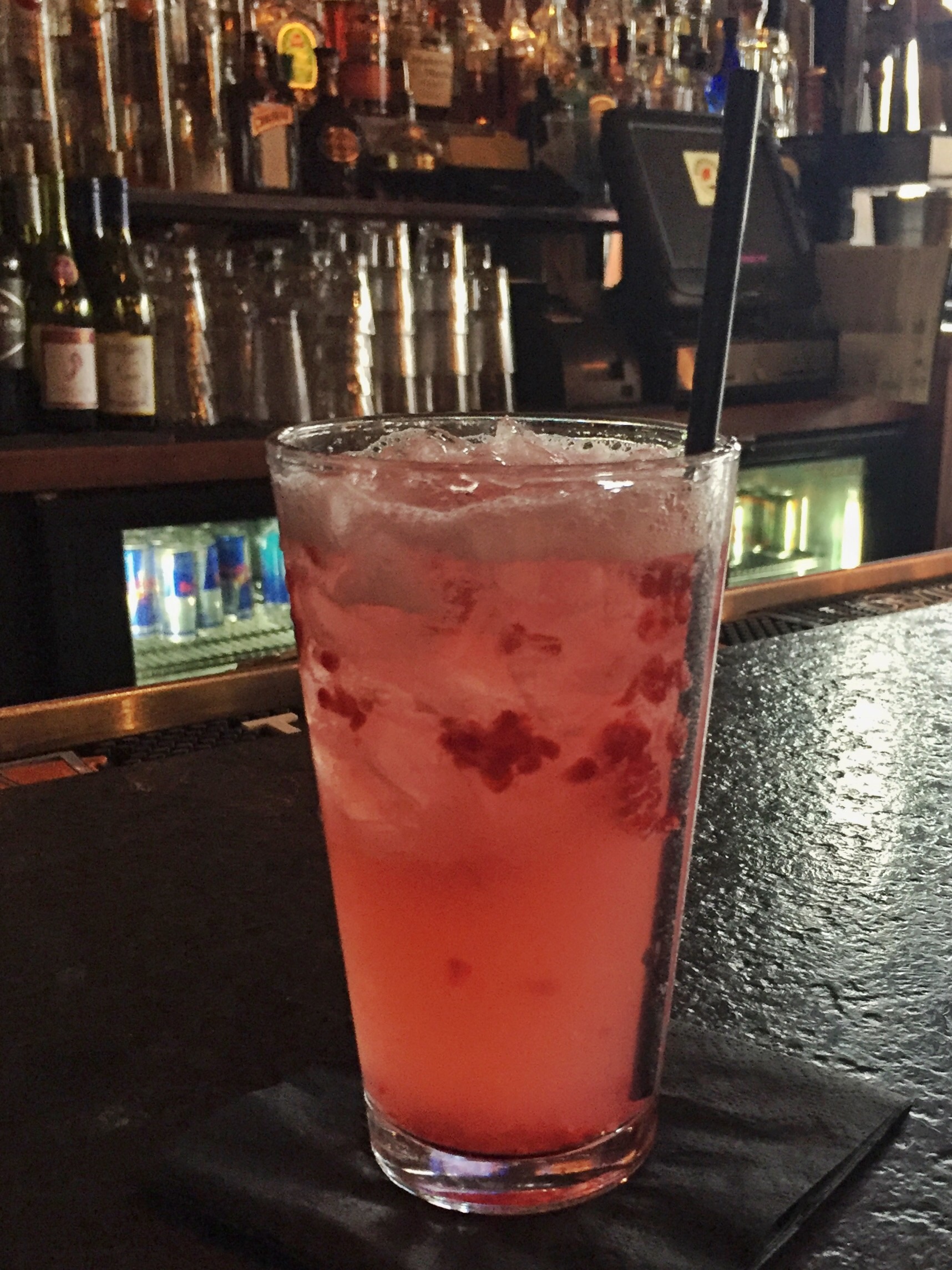
Definitely! It’s the ViewHouse Lemonade.
Ingredients:
1 ¼ oz Sky Raspberry
1 oz lemon juice
1 oz simple syrup
4 raspberries
Serve over ice in a pint glass, then top it off with a splash of Sierra Mist.
When you go to a new bar or restaurant, do you ever look around for anything that lets you know they have their sh*t together?
Of course. It’s just habit at this point.
Last but not least, what’s your favorite part of the job?
I’m the first person you see when you come into ViewHouse. I almost feel like the face of ViewHouse. I like meeting every person that walks through the door!
Thanks Dane and everyone at the ViewHouse for this awesome interview!