No Results Found
The page you requested could not be found. Try refining your search, or use the navigation above to locate the post.


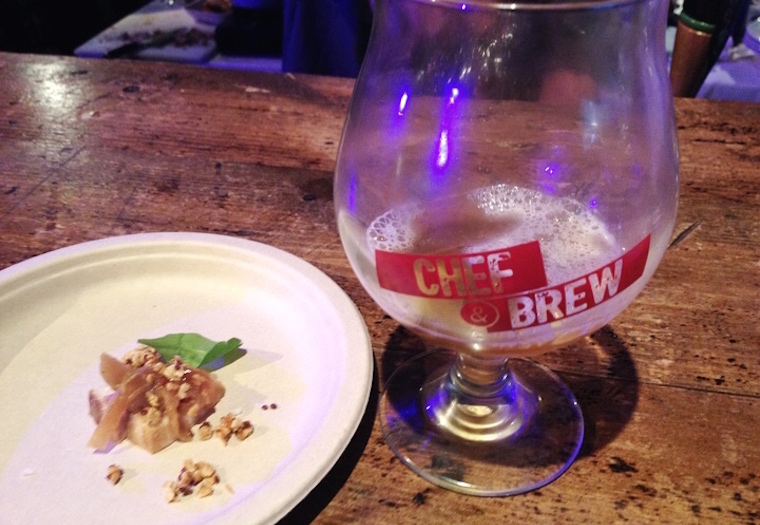
The colors of Denver’s bursting restaurant scene shined brightly last night at the 2015 Chef and Brew Festival. The festival featured some of Colorado’s most prominent restaurants and breweries teaming up to form unique amalgamations of craft beer and fine food. From sour beers and ramen to pork belly and Gotlandsdrika, 21 local restaurants and breweries flexed their creative muscles to reinvent the art of food and drink pairing.
What made this event so unique was that it not only reflected the innovativeness of Colorado’s craft beer and food scenes, but also the daringness exhibited by the teams in pairing esoteric beer and exquisite food to accent the flavors of each.
Each restaurant offered both a savory and a sweet option, allowing for a variety of pairings with the breweries. The chefs and brewers flipped the conventional notion of food pairing on its head by meshing unlikely flavor profiles together, a stark contrast to the ever-so-predictable wine and cheese pairing.
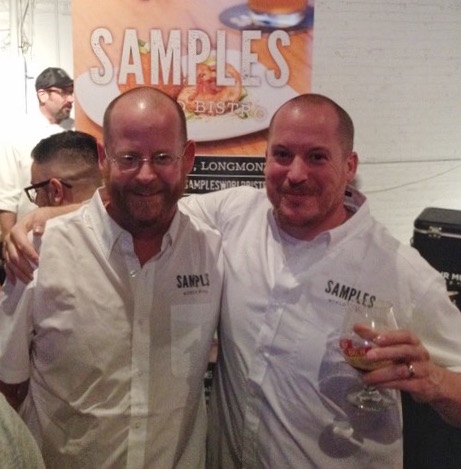
While beer and food pairings are nothing new, Chef and Brew took the game to a whole new level by introducing uncommon approaches to highlighting taste. Darrell Jensen, Executive Chef of Samples World Bistro, exemplified this edgy experiment. Teaming up with the Great Divide Brewery, Jensen prepared a dashi-marinated shrimp lettuce wrap to pair with the brewery’s Titan IPA. It may sound like an odd pairing; a light and fresh dish with a hop-heavy IPA? But however odd it may seem, it worked! The hops accentuated the dashi broth in the shrimp while the crisp finish of the beer combined with the dish’s bib lettuce, pickles and carrot made for a truly delicious experience.
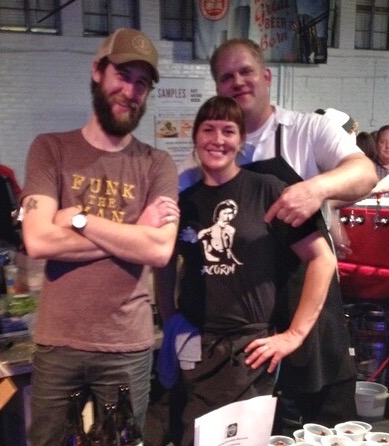
The pairing presented by Acorn and River North Brewery was the epitome of the night’s uniqueness, serving a chicken and pork belly ramen with the ‘Oud Bruin’ Belgian-style brown sour beer. Having won the contest last year, Chef Amos Watts and River North picked up where they left off by masterfully masking the dominant sour taste of the Oud Bruin with a hearty, savory ramen soup. Amos’ success in dismantling the structure of a sour beer with opposing, yet somehow complementary flavor profiles demonstrated the creativity illustrated at the event.
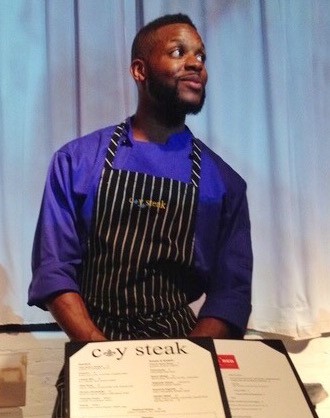
On tap were some of Denver’s most experimental and new-age beers. Jagged Mountain Brewery provided two of the most intriguing beers, a Swedish-style smoked-malt Gotlandsdrika called “Men Who Drink from Goats” and a Grizzly Peak session porter. Teaming up with Anthony Smith and CY Steak, Jagged Mountain accentuated Smith’s pork belly and arugula dish, delivering a powerful blow of lasting smoky richness when combined with the Gotlandsdrika.
The session porter, a prime example of the event’s innovative beer technique, reflected the dynamic world of Denver craft brewing by taking a traditionally heavy beer and transforming it into a light, low-alcohol-content session beer to be paired perfectly with Smith’s sweeter dessert.
The inventiveness displayed by all of the participating restaurants and breweries most definitely showcased the bountiful talent and enormous originality of Colorado’s food and brew scenes.
For me, the Chef and Brew Festival opened my eyes to the developing identity of Colorado’s food and beverage industry. With a vibrant craft brewing community rapidly taking root here in Colorado, the local restaurant industry is taking advantage and leveraging peoples’ propensity for unique beers by catering their tastes to match. Festivals such as this clearly demonstrate that this is what the future holds for the food and drink scene. As a Colorado resident, I am eager to see this trend continue and watch as the restaurant and brewing industries form a new and intertwined culture.

For restaurant and hospitality businesses, the winter season means ramping up staff to handle the holiday rush. Hiring is hard in general, but when it’s the seasonal sort, things can go bad fast. So, we put together an easy guide that will help lighten the load.
To ensure a successful holiday season, carefully consider what your company’s needs will be in the weeks and months ahead.
Do this by comparing last year’s numbers to current data while taking into account growth and upcoming specials.
Start by reviewing your previous year’s traction prior to and throughout the winter months to give you a sort of baseline. Then compare it to the current year’s highlights that could impact your anticipated volume such as reservations, sales, events, social media presence, press, etc. Another aspect to take into account are any holiday promotions, events, and campaigns that may drive volume in the coming months.
Marry the data you gathered to plan ahead for potential gaps in coverage, departments, jobs, and days of week/times of day. This will then give you the information you need to successfully hire additional staff for the season.
When managers, operators, and owners approach seasonal hiring as just a temporary adjustment, there is often little consideration given to the long-term effects this will have on the company, permanent employees, and customers. Although the positions and those filling them may indeed be temporary, making hiring decisions on the fly rarely works out well.
With coverage needs thoroughly identified, job descriptions and postings can be very specific and detailed in terms of the experience, qualifications, and skills required for each role you need to fill.
This helps to ensure that applicants are aware of your needs and if they are a match. This will inevitably lead to higher quality applicants thereby making it significantly easier on you and your hiring staff when making the final decisions.
When it comes time to actually hire, don’t be hasty in the decision. To be confident that your seasonal employees will only help your cause, not hurt it, get all the facts before making the call. As you would with permanent employees, check that their experience, skill-set, and personality are appropriate for the position and your company. It can be hard to do all this in the limited time you have to hire, so use all of the resources available to you.
As the holidays approach and volume starts ramping up, it can be easy for both managers and long-term employees to get caught in the storm and lose sight of the fact that quality customer experiences are an outcome of employee experience, including those of seasonal employees. If seasonal hires are treated like machines and given little respect by superiors and coworkers, performance and profitability will suffer.
When employees are treated fairly, they can better focus on performing well on the job.
Avoid this by treating seasonal employees with the same care as their non-seasonal counterparts. To do so, cultivate a positive culture and implement the appropriate systems and solutions that acknowledge the importance respect in the workplace. This includes ensuring that permanent staff of all levels give the same support to seasonal employees as they would to each other, properly scheduling all staff as to allow for maintained work-life balance through the busy season, and being consistent in regard to managing the changes that come with the seasonal nature of the industry.
You’ve done all this great work in sourcing additional talent for the season, so don’t let it go to waste. Be deliberate about keeping in touch with your seasonal hires so that you can recruit them in following years, or, if the situation arises, you can hire them permanently in the future.
A great way to establish continued communication is by having an exit interview of sorts.
It doesn’t have to be formal, just a way to initiate a dialogue. Provide feedback on performance and ask for it in return. Inquire about their interests and potential availability in the future. If nothing else, it will reinforce the positive experience they had while working for you, which is the impression they’ll share with their communities and networks. It’s great press!

Skilled bartending has become an intriguing, flashy trend, inspiring a plethora of competitions all over the world. From dazzling bar flare to unique cocktail recipes and speed bartending, these events are catching people’s eye and developing a strong following. But in this world of colorful drinks and innovative mixology, the art of basic service technique and bar knowledge falls by the wayside.
Together, Monkey Shoulder and the United States Bartender’s Guild (USBG) have created an innovative international competition that refocuses the art of bartending by challenging competitors to demonstrate their knowledge and service rather than just their flare. Labeled a “no b.s.” competition by the members of the Monkey Shoulder team, the event aimed to focus on “skills that pay the bills,” a no-nonsense, practical take on being a good bartender.
Lead by Dean Callan, Brand Ambassador at Monkey Shoulder, the event has traveled to four other U.S. cities including Milwaukee, Charleston (SC), Chicago and Philadelphia and internationally, in Malaysia, Vietnam, Philippines, Poland, France, Germany, and Singapore. Bartenders from each city took part in the same 7-round competition and the overall point leader at the end of this year’s competition will be crowned the Ultimate Bartending Champion.
On Monday, November 18th, 2015, the Ultimate Bartender Championship came to Denver. Hosted by Punch Bowl, the competition featured 12 local bartenders, competing in 7 different rounds that tested their technique, insight, speed and skill behind the bar.
1. Quiz:
In the quiz round, contenders were read 100 multiple choice questions ranging from an array of bartending topics. From identifying recipe ingredients to naming various countries’ national beverage, Callan rapidly quizzed the opponents to test both their knowledge of beverages and their ability to think quickly on their feet.
2. Mixiodic Table:
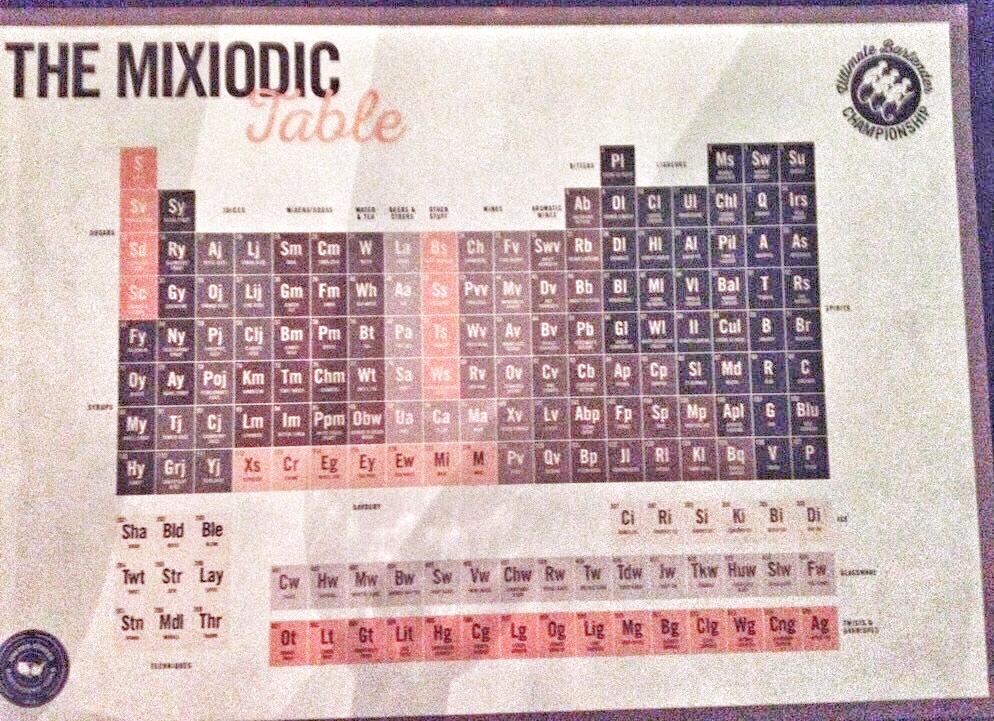
For the competition, Callan and the Monkey Shoulder team created an ingenious bartender version of the periodic table. The table consists of various components to cocktail recipes, featuring ‘elements’ like sugars, juices, mixers, bitters, ices, liquors, glassware and garnishes. The goal for this round was to solve ‘equations’ by naming the cocktail. For instance, if Vm=vermouth and V=vodka, Ol=olive juice, Sh=shaken, Up=martini glass then V+Vm+Ol+Sh+Up = A vodka martini. Competitors had 10 minutes to solve 20 equations.
V+Vm+Ol+Sh+Up = A vodka martini
3. Nosing:
In this round, opponents had two minutes to identify ten different spirits in a blind nosing test correctly. 1/2 a point was awarded for knowing the spirit (i.e., vodka, bourbon, scotch, Irish whiskey) and a full point for naming the brand (42 Below vodka, Glenmorangie scotch, etc.).
4. Pouring:
This task included glasses listing specific pour quantities (1/3 oz, 1 oz) and the bartenders needed to measure out the exact pour for each. The goal here was to pour the right amount into each glass and be exact on as many as possible while being as quick and efficient as possible.
5. Tray Service:
This round required competitors to take drink orders for ten people, get the drinks from the bar and, in the correct order, serve the right drinks to each corresponding person. To do this, Callan printed off ten pictures of celebrities and recognizable people to serve as the ten places at the table. By doing this, it required the bartenders to remember who ordered which drink and place each drink down in the correct order (women first, than men). Each opponent had a different arrangement of pictures and needed to adapt to the right order. Again, this pushes the importance of service technique, efficiency and drink knowledge.
6. Stock Take:
A crucial part of being a bartender is inventory. This round featured the skills of taking stock of various liquors as if they were doing inventory. Competitors needed to eyeball measure the amount of liquor in 10 different bottles and output an accurate inventory sheet.
7. Building Challenge:
The final round required the competitors to produce eight cocktails in 5 minutes. These cocktails were taste-tested by the audience. If the audience decided that a cocktail was not adequate, they could send the drink back, therefore, docking points from the bartender. This last round was in place to showcase the skills and mixing techniques of the competitors and tested how they managed their time while optimizing taste and technique.
The competition was a captivating, enjoyable experience that drew a great deal of interest due to its uncommon, practical nature. While the notion of a service knowledge and recipe knowledge-based event may seem pedestrian, Callan and Monkey Shoulder did a phenomenal job with their innovative challenges, unique creations (like the Mixiodic Table) and focused on bartending functionalism and skill. Both competitors and spectators enjoyed this new format, and all benefited from the showcasing of no-nonsense bar knowledge and service technique.
As a member of the food and beverage community, I believe that this innovative, practical-knowledge-based event is exactly what the industry needs. Yes, bar flare is fun and captivating, but the importance of service is what keeps the industry alive. Callan did an extraordinary job of incorporating functional, pragmatic bartending skills into a competitive, unique event. His focus on “skills that pay the bills,” I believe, will inspire more bartenders to pay closer attention to the importance of the basics; knowledge, efficiency, preciseness and good service. I admire Callan’s ingenuity and creativeness in bringing service into the forefront through useful yet fun skill challenges.
While this is the first year of this competition, Callan and Monkey Shoulder look to expand the event throughout the globe, creating new innovative challenges along the way and spreading the focus of service and technique. We can’t wait to see what they have in store for next year and the years to come.

Upselling is an elemental part of good service and it benefits everyone: your guests will get better quality food and drink, you’ll get a higher tip average, and your restaurant will do better in sales! With this said, upselling is absolutely an art form. It’s a skill that requires practice, knowledge and a keen ability to read your guests. Needless to say, perfecting this will do wonders for you as a server! So, part three of our serving hacks series is all about mastering the art of upselling.
In order to successfully upsell menu items, you have to know them inside and out, and know a clever, enticing way of describing them. The basic idea here is to recite qualities and characteristics of a cheaper dish and compare them to a more expensive item with richer, more eloquent descriptions.
Do not necessarily assign value-judgement in your description. Simply use brighter, more sophisticated language to highlight and accentuate that the more-expensive dish is clearly better.
Simply use brighter, more sophisticated language to highlight and accentuate that the more-expensive dish is clearly better.
The more exacting you are in your description, the more likely the guest is to trust your knowledge. This takes some practice because if you fumble around and seem unsure of what you’re saying, your attempt at upselling could backfire. You absolutely do not want your guests to know your trying to get them to spend more, even if it is for a better quality product.
Pro-tip: A good trick is to be passionate and animated in your description. Your enthusiasm will be contagious and will bring your guests’ excitement to a whole new level.
A successful server not only knows their menu but knows what they want to sell to their tables. Personally, I like to sell the same things to each of my tables. The reasons for this are:
Practicing what you’re talking about makes you not only feel more confident, but also makes you look more competent, and this is a must when you’re upselling.
No two tables are alike. As much as you think the dapper couple at your table is able to spend money or the teenagers at the other table will be cheap, you never really know. So, while I like to upsell the same menu items, my MO varies depending on the guests.
Initially, it’s best to approach all tables the same way; composed, professional, and unassuming. Once you engage with the table, you can then determine how to proceed throughout the rest of the meal.
While I like to upsell the same menu items, my MO varies depending on the guests.
If you get the sense that the table is playful, then make some jokes when talking up your suggestions. On the other hand, if you’re getting a more formal vibe, go with a fancier explanation.
It can be hard to get a good feel for your customers, so always err on the side of caution as to avoid mistakes. However, if you accurately read your guests and determine the sales method they’ll respond to best, you’ll undoubtedly reap the rewards.
“If I was on death row, and my momma wasn’t there to cook for me, this is what I’d eat.”
Upselling is the mark of a comfortable, successful server. Being subtle but determined in your approach is key. Make sure you know your menu well enough to upsell and that you are able to correct mistakes and save yourself if you misstep. Matching your personality to your upselling tactic is the goal. If you can accomplish this, you can do amazing things for your guests, your restaurant and yourself. Hope this helps!
The page you requested could not be found. Try refining your search, or use the navigation above to locate the post.
Sign up now to find hospitality jobs and hire top industry talent.

The turnover rate for employees in the restaurants-and-accommodations sector rose for the fourth consecutive year in 2014, though it remains relatively low in historical terms. Restaurant employee turnover is higher than the private sector due to several factors, including higher proportions of teenagers, students and part-year employees in the industry workforce, according to the NRA’s chief economist Bruce Grindy. His Economist’s Notebook commentary and analysis appears regularly on Restaurant.org and Restaurant TrendMapper.
The turnover rate in the hospitality sector rose for the fourth consecutive year in 2014, but remained below pre-recession levels, according to data from the Bureau of Labor Statistics’ Job Openings and Labor Turnover (JOLTS) program.
The overall turnover rate in the restaurants-and-accommodations* sector was 66.3 percent in 2014, up 10 percentage points from the recent low of 56.6 percent in 2010.
Despite the increase, the turnover rate remains relatively low in historical terms. In 2007, prior to the economic downturn, the turnover rate of the restaurants-and-accommodations sector was 80.9 percent. This was generally on par with turnover in the previous five years (2002-2006), when the annual rate averaged 80 percent.
In comparison, the average turnover rate for all private sector workers stood at 44.4 percent in 2014, up four percentage points from the 2010 low but still below the average turnover rate of 50 percent during the 2002 – 2006 period.
The JOLTS program breaks turnover into three components, with the sum of the parts representing the overall turnover rate. The quits rate in the restaurants-and-accommodations sector was 46.5 percent in 2014, while the layoffs-and-discharges rate was 17.2 percent. Other separations, which include retirements, transfers, deaths, and separations due to disability, comprised 2.6 percent of the sector’s turnover rate in 2014.
Most sectors of the economy saw their overall turnover rates decline during the challenging economic environment of 2008 – 2010, as workers were less likely to quit their current jobs with fewer other employment opportunities available. However, the quit rate rose in recent years, which indicates that workers are becoming more confident in the labor market and are willing to jump to another job.
Restaurant industry turnover tends to be higher than overall private sector turnover for a number of reasons. First, the restaurant industry is the economy’s largest employer of teenagers, as one-third of all working teenagers in the U.S. are employed in a restaurant. Many of these 1.5 million teenage restaurant workers are getting their first job experience, and will go on to start a career with a different employer, either inside or outside the restaurant industry.
Second, the restaurant industry employs a high proportion of students, who typically don’t work on a full-year schedule. Twenty-eight percent of eating and drinking place employees are enrolled in school, versus just 11 percent of the total U.S. employed labor force, according to the U.S. Census Bureau’s 2013 American Community Survey (ACS).
The restaurant industry also boosts seasonal staffing levels at various points throughout the year, which adds to the normal cyclical turnover numbers. For example, the restaurant industry is one of the economy’s largest creators of seasonal jobs during the summer months, adding more than 400,000 jobs during an average summer season. Overall, 31 percent of the eating and drinking place workforce are part-year employees, compared to 19 percent of the total U.S. workforce, according to the ACS.
Full-year employees also contribute to the industry’s comparatively higher turnover rate, as upward mobility in the restaurant industry often happens when employees move from one restaurant to another. More than any other industry in the economy, the existence of multiple restaurants in nearly every community gives employees additional opportunities for upward mobility and career growth.

*Note that the turnover figures presented are for the broadly-defined Accommodations and Food Services sector (NAICS 72), because the Bureau of Labor Statistics does not report data for restaurants alone.